
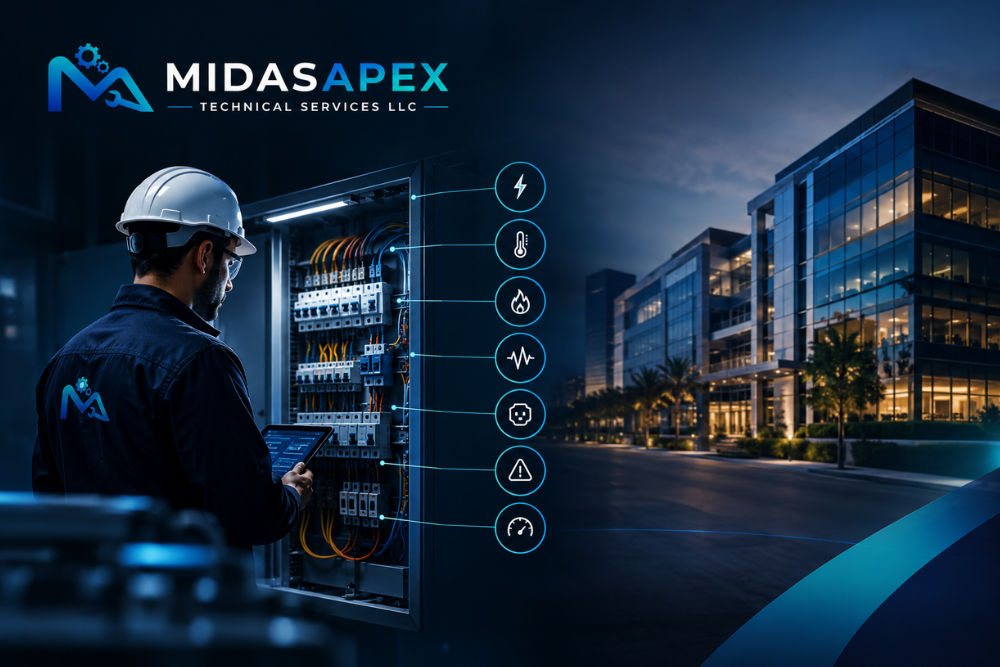
A tripped breaker on a Tuesday rarely feels like an emergency. In a Dubai office tower, mall unit or warehouse, it can be the first visible symptom of a fault that is already generating heat behind a panel door. Electrical problems in commercial buildings seldom arrive without notice. They announce themselves through small, repeatable signals that facility teams often log as nuisances. This guide sets out seven of those signals, what each one usually means, and what to do in the first hour, so your team acts while the repair is still a maintenance job and not an incident.
Quick answer: The seven early warning signs of electrical problems in commercial buildings are frequent breaker trips, flickering lights, burning smells, warm panels, sparking outlets, unexplained bills and repeated equipment failures. Any one justifies inspection by a licensed contractor; two or more together mean urgency.

Electrical Fault Signs Your Team Can Spot Without Tools
Dubai Municipality is the primary authority for building and technical compliance in the emirate, and responsibility for a safe installation sits with the people who operate the building. The first four warning signs need no instruments, only attention.
1. Breakers that trip repeatedly. A breaker is a safety device doing its job. When the same one trips twice in a week, it is reporting an overload, a short circuit or a failing connection. Resetting it again and again hides the cause and wears the contacts. Record the circuit number, the time and the equipment running.
2. Lights that flicker or dim. One flickering lamp is usually just a failing lamp. Flicker that follows the start-up of a chiller, lift or compressor points to voltage drop, often from a loose neutral or an overloaded feeder. It tends to surface in July and August, when cooling load peaks.
3. Burning smells or scorch marks. A sharp plastic or fishy odour near a panel, socket or switch means insulation is overheating. Brown marks around an outlet confirm it. Isolate the circuit and call a contractor the same day.
4. Warm panels, buzzing or humming. A distribution board should sit at room temperature. A warm door or a steady buzz from one breaker suggests a loose terminal or an overloaded bus. An infrared survey finds these hot spots before anyone opens the cover.
Why Small Signs of Electrical Problems in Commercial Buildings Become Costly
Fire statistics explain the urgency. NFPA’s 2019 analysis of non-home fires involving electrical distribution and lighting equipment found that fires between midnight and 8 a.m. were 22% of the total but caused 53% of civilian deaths and 40% of direct property damage. The same research ties electrical-failure fires largely to arcing, an unintended discharge of current between conductors. A slow fault in an empty building at night has time to grow. The data is American, but a loose connection behaves the same way in a Dubai tower.
Three more signs complete the list.
5. Sparks, arcing or mild shocks. Visible sparks at a socket, a crackle as a plug goes in, or a tingle from a metal casing all mean current is leaving its intended path. Treat any shock report as a stop-work event, however mild.
6. Bills that rise while operations stay flat. Compare each DEWA bill against occupancy, operating hours and tenant fit-out changes. A jump with no explanation can indicate failing motors, degraded insulation or a fault leaking current to earth.
7. Equipment that fails early. Drives, sensors, LED drivers and control boards that die well before their rated life often point to surges or poor power quality upstream. Replacing them one by one treats the symptom and keeps the cause.
Notice the pattern across all seven: each is repeatable. A single breaker trip is an event; three trips on the same circuit in a month is a diagnosis.
What to Do in the First Hour and How to Prevent a Repeat
Speed and order matter more than heroics. If it is safe, isolate the affected circuit and keep people away from the area. Photograph the panel, note the time, and stop resetting breakers. Then bring in a licensed contractor. Report fire, smoke or injury to Dubai Civil Defence, and raise supply-side faults with DEWA.
Prevention costs less than response. A sound routine pairs planned electrical maintenance with an annual infrared survey of panels, torque checks on terminals, residual current device testing and a load log that captures summer peaks. Each task is small. Together they turn surprise faults into scheduled work orders.
What Should Building Managers Do When Electrical Warning Signs Appear?
- Should we reset a tripping breaker? Reset it once at most. If it trips again, leave it off, note the circuit, and call a licensed electrical contractor.
- When is a burning smell an emergency? Immediately. Evacuate the affected area, isolate the circuit if safe, and call Dubai Civil Defence on 997 if you see smoke or flames.
- How often should commercial electrical systems be inspected? Follow the interval set by your maintenance contract and local authority requirements, and add an infrared panel survey when loads change or signs repeat.
- Why do electrical faults cause fires? Arcing between damaged or loose conductors can produce enough heat to ignite nearby material, according to NFPA’s 2019 non-home electrical fires report.
Log the Signs, Then Act on Them
Electrical problems in commercial buildings rarely begin as emergencies. They begin as a tripped breaker, a warm panel or a bill that does not add up, and the teams that log those signals early keep repair costs and downtime low. If several of the seven signs above sound familiar, talk to Midas Apex about a scheduled inspection and maintenance plan, and get the fault diagnosed while it is still a work order.